
Engineering Students Place 2nd at National Bridge Competition
FOR IMMEDIATE RELEASE
June 9, 1999
Joe Wills
530-898-4143
Engineering Students Place 2nd at National Bridge Competition
California State University, Chico’s team of student civil engineers fell just short of the top prize at the American Institute of Steel Construction’s National Bridge Competition, finishing second overall. The competition was held May 27-28 at the University of Alaska-Anchorage.
CSU, Chico had won the Mid-Pacific Regional Competition at UC Berkeley April 10. It was the third straight year CSU, Chico had won the regional contest in bridge building.
West Coast universities dominated the national competition for the first time in the eight-year history of the event. In a very tight finish, University of Nevada-Reno won the event, followed by CSU, Chico. Cal Poly, San Luis Obispo came in third.
Twenty regional steel-bridge building competitions attracting 186 university entries were conducted across the United States and Canada in 1999. Teams qualified for the national event by placing first or second at one of the regional contests.
Forty universities convened on the Anchorage campus for the competition. The national entry list read as a “who’s who” of well-known engineering schools, including Penn State, Ohio State, University of Illinois, Texas A & M, Clemson and Washington State.
The competition consists of four categories of evaluation: construction speed, stiffness, efficiency, and economy, which are calculated from measurements of assembly time, bridge weight and bridge deflection under loading. The sum of the placings in each category determines a school’s final ranking, with the university having the lowest sum declared the winner. To win, a bridge must be fast, light and stiff, while still having adequate strength.
The contest provides an excellent test of student performance in a multi-faceted, comprehensive team project. All aspects of structural engineering are represented in the contest, including computer-aided design, materials, fabrication, construction, functionality and economics.
The bridges, fabricated from structural steel, are approximately 18 feet long, 4 feet wide, and typically weigh less than 80 pounds. Disassembled, the bridges must consist of pieces no larger than 5 1/2 feet in length and 7 1/2 inches by 7 1/2 inches in cross-section.
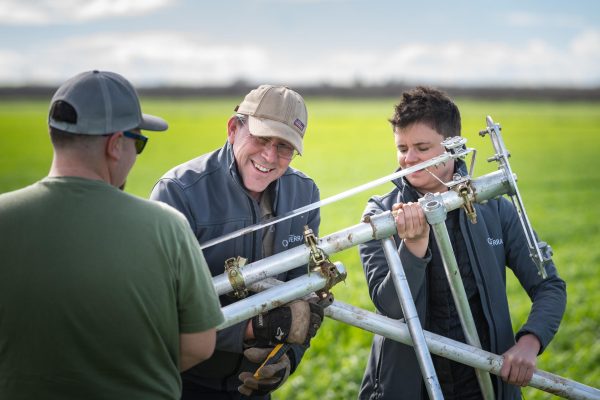
The major features of the competition are an on-site, timed assembly and load testing of each bridge. Teams may consist of any number of students, and this year teams ranged from two to five students. Since bridge assembly time is multiplied by the number of students to determine “construction speed,” a smaller team with a rapid assembly technique is optimal.
During assembly, students must carry structural members from the staging areas, through an obstacle course modeled after a congested construction zone, to the assembly abutments. Since the team members represent construction cranes, a single student may carry only one piece of the bridge at a time, while two students may carry an assembly of up to three pieces. Bridges typically consist of 25 or more individual pieces. The bridges are constructed over a 9-foot-wide simulated river, and teams are penalized if they step in the “water.” A competitive team will assemble their bridge in less than three minutes.
After assembly, the bridges must safely support an applied load of 2,500 pounds and deflect no more than 2 inches. The best bridges deflect less than 0.2 inches under loading, while many bridges collapse during the loading portion of the contest.
CSU, Chico and Nevada-Reno were closely rated by judges at the regional as well as the national competition. Nevada-Reno’s bridge was lighter than CSU, Chico’s, but Chico’s was stiffer and faster to erect. Chico won the two categories based on stiffness and speed, while Reno won the two classifications involving weight. The judges broke the tie based on aesthetics and contructability, also a close call, with the nod going to Chico.
At the national event, the bridges from the two universities were the top entries and again evenly matched. Both teams had modified their bridges since the regional match-up in an attempt to gain the upper hand, yet the two teams were virtually tied heading into the final phase of the competition. As an indication of the closeness of the competition between these two schools, the Chico team’s bridge came within 0.027 inches, about 1/32nd of an inch, during the bridge deflection phase of winning the event for CSU, Chico.
Members of the Chico team are civil engineering majors Jason Zwinggi, Jarrod Holliday and Josh Wallace. Faculty advisers are Russell Mills and Joel Arthur. Components of the Chico State bridge were fabricated by engineering technicians Jim Luallen and Mike Renwick, and logistic support was provided by the departmentÕs administrative coordinator, Dagmar Hampton.
CSU, Chico first participated in the competition four years ago, qualifying for the national event in only its second year of participation.
###